Neon Guide: Sprint Routes, Stun Timing, and Team Space
Written by Valorant Village
Source-backed coverage ●
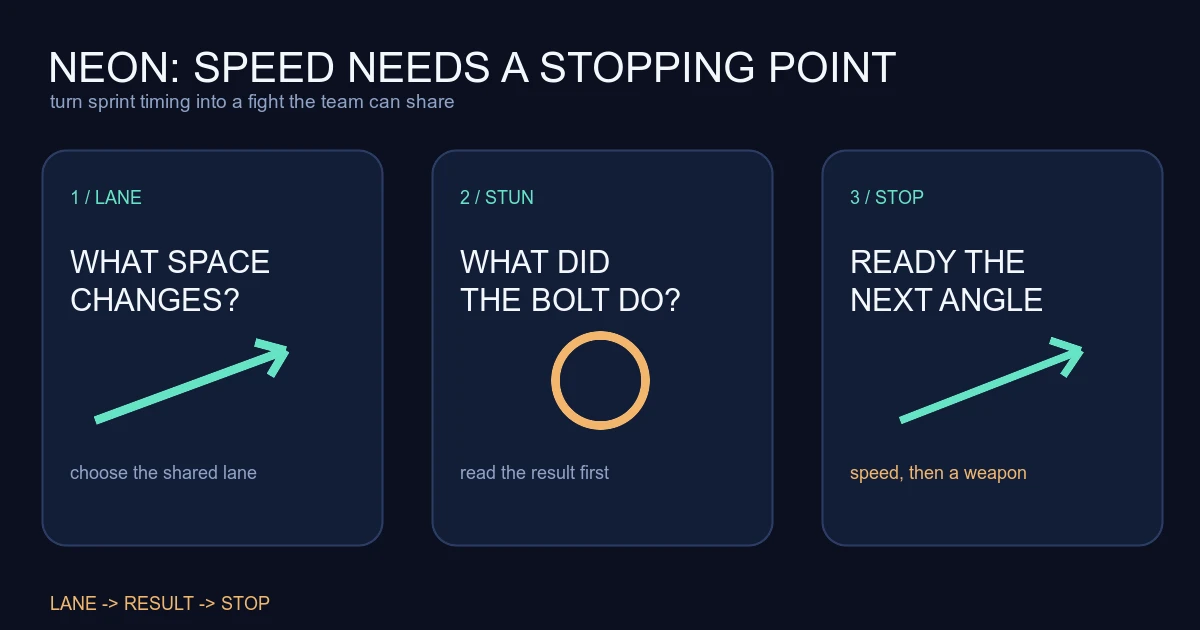
Neon's speed creates a very specific trap: the route feels useful because it is fast. You can arrive before your teammates, lose the first fight, and still feel as if you made the round happen. The useful test is slower. Did the sprint put the team in a better fight, or did it only move one player into danger sooner?
Neon works best when speed changes the timing of a shared play. You sprint through a lane while a teammate takes the next angle, use a stun to make the landing point playable, or use the wall to give the team a safer way to cross. Movement is the tool. The round decision is the product.
What Riot actually documents
Riot lists Neon as a Duelist. Its current Neon page describes Relay Bolt as an energy bolt that bounces once and electrifies the ground with a concussive blast when it hits a surface. Riot also describes High Gear's two energy lines extending along the ground into walls of static electricity that block vision and damage enemies passing through them.
Those details establish what the abilities are for. The route, timing and team communication below are Valorant Village coaching interpretation. Do not turn a general route into a promise that the same timing works on every map or patch.
Start with the lane, not the speed
Before sprinting, name the lane you want to change. It might be the first choke, the gap between two pieces of cover, or the route to a planted Spike. Then name the player who benefits from your movement. If no teammate can act on the space, the sprint is probably just a solo gamble.
Your route should also include a stopping point. Neon players often plan the start and the destination but not the first angle after arriving. Walk the route in a custom game and identify where you can stop without exposing the whole body. That pause is not a failure of speed. It is what lets the team catch up.
The general space guide is a useful check. Space means an option another player can use. It does not mean the fastest player reached the deepest landmark.
Relay Bolt should change the next fight
Use Relay Bolt when you know what the concussive result is meant to do. It can make a close angle less comfortable, interrupt a defender's hold, or give the sprint a better arrival. The throw is not complete when it bounces. Read the result and choose the next action.
Say the call before the bolt: “stun close, sprint through,” or “stun the hold, wait for my contact.” If the result misses the intended lane, do not keep running on the strength of your original plan. A missed stun can turn a fast entry into an isolated one.
The same rule applies after a successful stun. You do not have to fight the first player you see. If the defender gives ground, take the space and let the team occupy it. A forced retreat can be the value you wanted.
Use the wall for the team
High Gear can create a visual barrier that changes how a group crosses a lane. Treat it as a team shape, not a private running tunnel. Tell teammates which side you are using and what they should clear after the wall ends.
If the wall divides the fight, the entry player should not assume every defender is isolated. Keep the trade guide in mind: a teammate must be able to see the shooter and fight quickly. A wall that lets you reach a site but leaves the second player outside can create speed without support.
On defense, the wall can help you leave a dangerous lane or retake a piece of space. Do not use it only because the enemy is visible. Ask whether it blocks the angle that matters, whether your team can follow, and what happens when it fades.
The weapon problem after the sprint
Neon movement changes when you are ready to use your weapon. That makes the first moment after the sprint important. If you arrive with no crosshair plan, you may stop in an open lane and lose a fight to a player who was already holding it.
Choose the first angle before you move. When you stop, clear that angle with a teammate or utility. If you cannot stop safely, continue to cover or reset rather than forcing a shot while the movement habit is still in charge. The guide to losing gunfights after utility applies here too: separate the movement problem from the aim problem.
A simple Neon practice loop
In a custom game, mark one sprint route with a start, a stopping point and a first angle. Walk it once, sprint it once, then repeat with a teammate holding the trade. Add Relay Bolt only after you can explain what the first two versions are meant to solve.
In your next three matches, track one question: did the speed create a tradeable fight? Write down the lane, who followed, and whether the wall or stun changed the angle. If the answer is no, shorten the route. Neon improvement often starts by arriving less far away, with more of the team able to act.
Sources checked
- Riot Games Neon, checked in a live browser 2026-08-15 UTC. Used for Neon's Duelist role, Relay Bolt's bounce/concussive description and High Gear's vision-blocking wall description.
The lane rule, stopping point, team wall, trade test, weapon reset and practice loop are Valorant Village coaching interpretation, not Riot rules or guaranteed outcomes.