Omen Guide: Smoke Placement, Paranoia Value and Safe Teleports
Written by Valorant Village
Source-backed coverage ●
Omen is easy to make look busy. The smoke goes down, Paranoia flies, and a teleport marker appears somewhere ambitious. Then the round asks a much simpler question: what did that button help the team do?
His kit gets easier to use when every cast answers a sightline or a decision. I checked Riot’s current Omen agent page and the latest Riot patch listing on 2026-08-14 UTC. The ability facts below come from Riot. The placement and timing advice is Valorant Village interpretation.
What Riot currently confirms
Riot lists Omen as a Controller. His four abilities are Paranoia, Dark Cover, Shrouded Step and From the Shadows. Paranoia fires a shadow projectile that briefly reduces the vision range of players it touches and can pass through walls. Dark Cover creates a long-lasting shadow sphere that blocks vision; its targeting controls let Omen move the marker farther or closer before throwing it.
Shrouded Step starts a brief channel and teleports Omen to the marked location. From the Shadows uses a tactical map; while teleporting, Omen appears as a Shade that an enemy can destroy to cancel the teleport. Those are Riot’s current descriptions, not shorthand for “blind everyone” or “land anywhere safely.” Riot’s Beginner’s Guide also tells players to ask whether an ability helps achieve the next goal and to use Agent skills alongside teammates. That is a good test for Omen.
Dark Cover: smoke the sightline, not the minimap
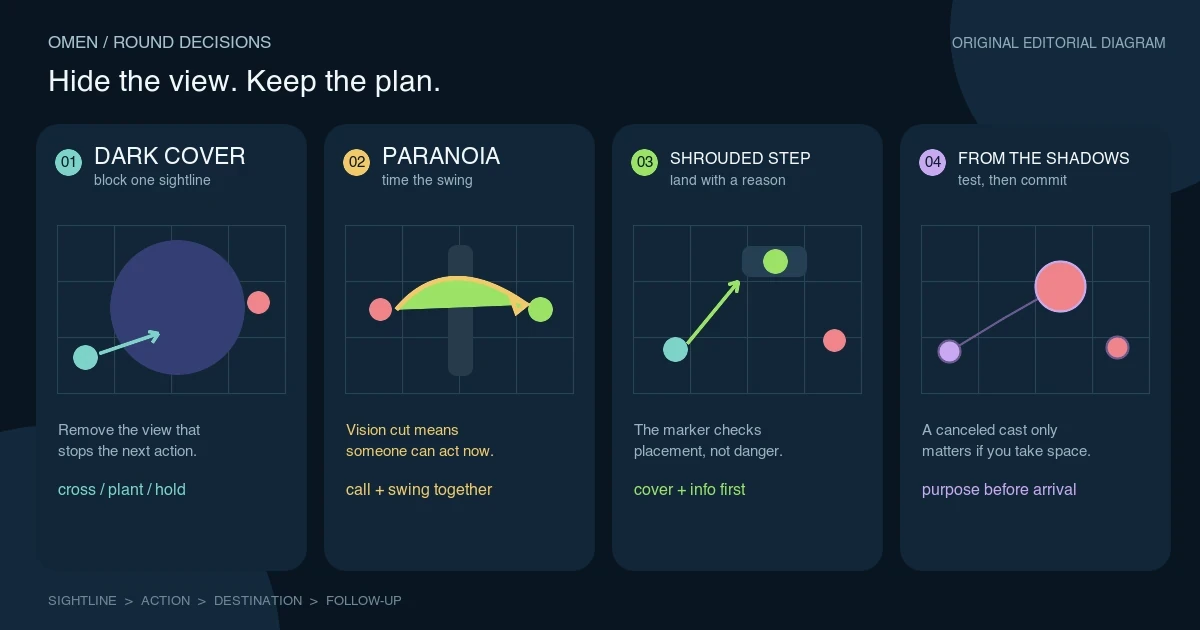
Start with the view that stops your team’s next action. On attack, that might be the defender’s long angle over the entrance, the view that sees the plant, or the line that lets two defenders pinch the same doorway. On defense, it could be the lane attackers need to cross before they can split the site. The useful question is, “What can the enemy no longer see, and what are we doing while that view is gone?”
Place the smoke so the next step ends in cover, a plant, or a fight your teammate can answer. A cloud in the middle of a site may look generous but leave your team guessing which edge is playable. A smoke that hides your own exit can still be correct, but say what it is buying. “Smoke down” is not a plan. “Smoke down, cross now,” “smoke down, wait for contact,” or “smoke down, plant” gives the team a clock.
Do not spend the second smoke because the marker is available. Keep it for the next problem: a rotate, a retake, a post-plant defuse angle, or the sightline that appears after the first fight. For a broader explanation of what teammates should do with a Controller’s smoke, read our guide to playing around smokes. The Omen-specific part is choosing the view that matters next.
Paranoia: make the reduced vision matter
Riot’s wording matters here. Paranoia briefly reduces vision range; it is not a promise that the affected player becomes harmless. Its value is highest when a teammate is ready to take space during that short window.
Call the direction and the action together: “Paranoia through the wall, swing with me,” or “Paranoia close right, take site.” Fire it through a wall to reach a defender behind cover, then make the fight arrive on the same beat. If the enemy gives up the angle, your team may have won space rather than a kill. That still counts as value if somebody uses the space.
When nobody can act, save it or use it to make a contact safer. Throwing Paranoia on cooldown into an empty lane feels productive for about one second. Then the real fight starts and the ability is gone. Before pressing the key, name the fight it supports: an entry, a close-angle clear, a retake swing, or a defender who has to choose between holding and moving. If you cannot name one, wait.
Shrouded Step: a marker is not a clear
Riot’s current description says Shrouded Step has a range indicator, a brief channel and a marked destination. Riot’s Patch 13.02 notes, published 2026-07-29, say the missing obstructed-placement indicator was fixed. As of my 2026-08-14 UTC check, Patch 13.02 was the newest patch on Riot’s Game Updates list.
Use that indicator as a placement check, not as a security report. It can tell you whether the destination is obstructed. It cannot tell you who is holding the landing spot. A safer teleport has a reason to exist, lands behind cover or changes the angle of the fight, and has some information or teammate pressure behind it. A smoke can hide the arrival. It cannot clear the corner for you.
Shrouded Step is also a fine escape when it breaks a known line and leaves you somewhere playable. If it only moves you from one exposed duel into another, the marker has solved the wrong problem. Ask what happens immediately after the channel: who sees the next angle, who trades you, and where do you go if nobody fights?
From the Shadows: choose the purpose before the map
From the Shadows can threaten an arrival elsewhere on the tactical map, but the map does not choose the round’s objective for you. Before you cast, pick one job: gather information, pull defenders’ attention, change the route, or arrive somewhere that your team can actually hold.
The enemy can destroy Omen’s Shade and cancel the teleport. A canceled cast may still force a defender to look away, but call it useful only if your team takes something from that moment. If the Spike is stranded, the site is lost, or the arrival leaves you alone in an uncleared corner, the dramatic part of the play is not the same as progress.
Before any Omen cast, ask four questions:
- Which sightline or player is this ability affecting?
- Who acts next, and what is the timing?
- What information makes the destination reasonable?
- What is the fallback if the enemy does not give the fight?
If the answer is clear, Omen’s shadows stop being decoration. They become a way to make one particular fight easier to take. For the communication piece, our VALORANT comms guide has short call formats; our sound-cue practice list is useful when you are trying to separate what you heard from what you guessed.
Riot’s ability descriptions tell you what Omen can do. The round still depends on whether the team knows why you did it.