Pearl Mid: How to Take Space Without Losing the Round
Written by Valorant Village
Source-backed coverage ●
Pearl mid is attractive because it offers a route that feels like progress. You enter, see a little more of the map, and then discover that the team has no agreement about what the space is for. Taking mid is not the round plan. It is a way to create a better next choice.
What Riot documents
Riot's current VALORANT Maps page describes Pearl as a two-site map in an underwater city. Riot calls it a geo-driven map with no mechanics, and says its compact mid and longer-range wings create different fights. The page does not prescribe a universal mid route, plant, or utility order.
Riot's Beginner's Guide says to learn maps, remember where enemies can come from, watch angles, check corners, ask whether an ability helps the next goal, and communicate with voice, pings, or Agent voice lines. Those are the source-backed habits. The mid checklist below is Valorant Village coaching interpretation.
Define the space before you take it
Before the first player moves, name the useful outcome. Are you trying to pull a defender from a site? Protect a route for the Spike? Create a split? Force information before defaulting elsewhere? If nobody can answer, the team may be walking into mid because the route is available rather than because it improves the round.
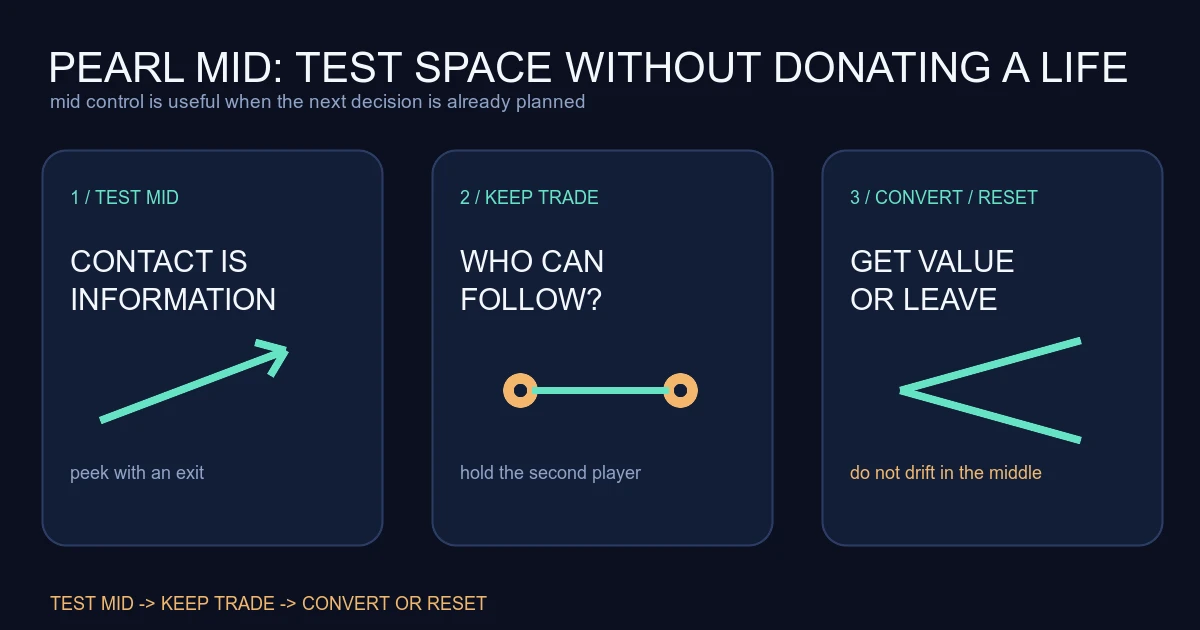
Give the first player a job and the second player a line. “I take first contact, you hold my trade” is enough. A third player can own the exit or watch for a response. Compact mid does not mean a five-player stack is automatically safe. It means the next angle can arrive quickly, so the team should know which angle it is ready to fight.
The guide to playing for space gives the larger test: space matters when it creates a usable option. On Pearl, that option might be a site split, a safer rotation, or a forced defender move. If mid gives you none of those, holding the route can be better than walking deeper.
Use information to choose the next lane
Mid information should change a call. A defender seen on one side may leave another route uncertain. A sound may suggest a response without proving a full rotation. A utility result can tell you that a lane is contested, not that the rest of the map is empty.
Call fact, location, and unknown: “one seen near the mid entry, site count unknown, hold while we check the wing.” That keeps the team from converting one sighting into a forced duel. The sound-cue practice list is useful when you need to separate the sound itself from the story attached to it.
Do not spend every piece of utility to make mid look owned. Use an ability when it protects the next move, helps a teammate cross, or changes who can contest. Once the intended information arrives, equip the weapon and let the team decide whether to convert or reset.
Know when mid is doing its job
Mid is working when your team can name the option it created. You may have pulled a defender away from the site, made a wing safer for the Spike, or forced the enemy to reveal a response. You do not need a kill for that to be useful.
Mid is failing when the first player is isolated, the second player cannot see the same fight, or the Spike has no route after the contact. A defender holding a lane is information. It is not a personal challenge. Stop at the last space that remains tradeable and ask whether another route keeps more choices alive.
The defaulting guide explains why a slow round can be stronger than a forced entry. Giving mid back is not always losing. Sometimes the information is valuable because it lets you attack a different lane with a clearer idea of the response.
Practice the decision in a custom game
Walk one Pearl mid route without abilities. At each junction, say the first contact, the teammate's trade line, the likely defender response, and the exit. Repeat with one piece of utility. Record what changed, then stop. The drill is about deciding when space is usable, not memorising a sequence that assumes nobody reacts.
In live rounds, review three mid attempts. What was the job? What did you confirm? Who could answer the first fight? What did the team do after the result? If the answer is “we took mid and waited,” the next improvement is a clearer conversion call.
Sources checked
- Riot Games VALORANT Maps, checked in a live browser 2026-08-15 UTC. Used for Pearl's current two-site, geo-driven, compact-mid and long-wing description.
- Riot Games Beginner's Guide, published 2024-08-02, checked 2026-08-15 UTC. Used for map learning, angles, next-goal utility, movement, and communication.
The mid checklist, trade conditions, conversion test, and practice drill are Valorant Village coaching interpretation, not Riot rules or a fixed Pearl meta.