Viper Icebox Setups: What to Learn Before Memorising Lineups
Written by Valorant Village
Source-backed coverage ●
Memorising a Viper lineup can feel like progress because the throw either lands or it does not. On Icebox, that binary test hides the real problem: you may know where to stand without knowing what the toxin is meant to change, who it helps, or what you do when the round moves.
Learn the job before the throw
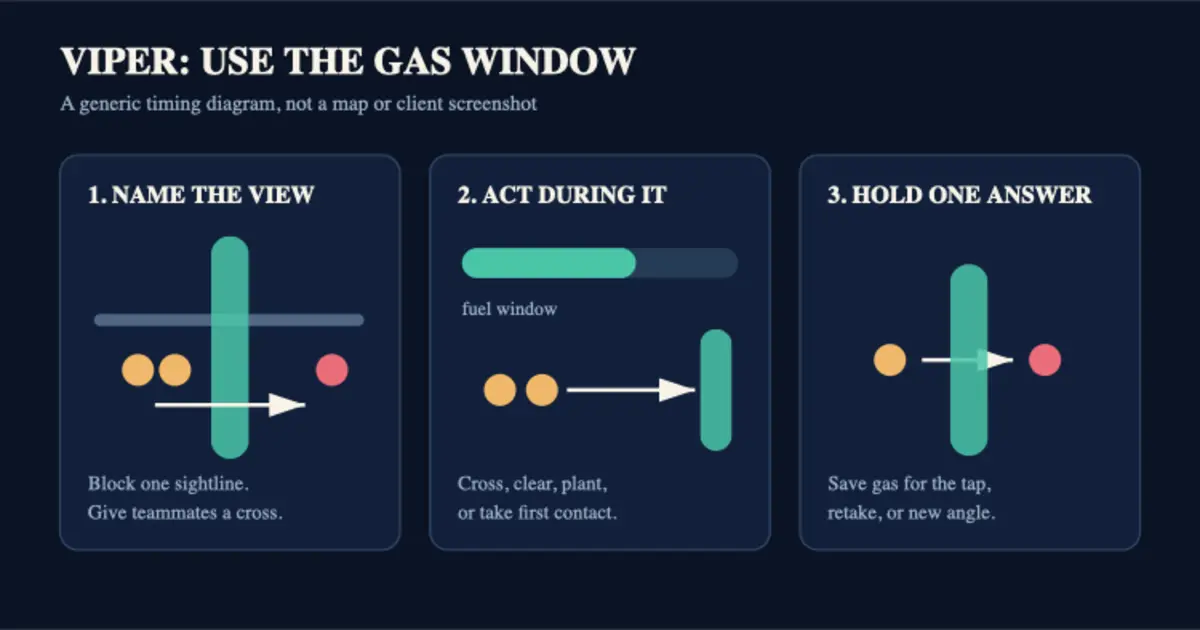
Riot lists Viper as a Controller. Its current Viper agent page describes Poison Cloud, Toxic Screen, Snake Bite, and Viper's Pit as tools that block vision, create toxic zones, or change the conditions inside a cloud. Those are Riot-documented facts. The job labels and practice rules below are Valorant Village coaching interpretation.
Before you open a lineup video, finish this sentence: “This setup lets our planter cross,” “This setup gives us a safer fight after the plant,” or “This setup makes the defuse route costly while I stay alive.” If you cannot name the job, the throw is not ready for ranked play.
Riot’s VALORANT Maps page describes Icebox as a Kingdom excavation site overtaken by the arctic. It says the two plant sites are protected by snow and metal, calls for horizontal finesse, and mentions ziplines. Those details tell you to test movement and sight-line changes around the objective. They do not supply a universal Viper setup, and they are not a reason to copy someone else’s exact aim point.
What each piece of utility is for
The Viper page says Poison Cloud creates a toxic gas cloud at the cost of fuel, that the emitter remains throughout the round, and that it can be picked up for redeployment before the round starts. It also says the cloud can be reused more than once. Toxic Screen creates a tall wall from a long line of emitters and can also be reused. Snake Bite creates a lingering zone that damages and slows enemies. Viper’s Pit creates a large cloud that reduces vision range and maximum health for players inside. These are Riot-documented descriptions, not promises about a specific Icebox plant or post-plant result.
Turn each description into a question. Which sight line does the wall remove? Which route does the orb make harder to hold? Who can cross while the screen is active? If Snake Bite is for the post-plant, what information tells you to use it, and where is your gun when the fight starts? If you place Viper’s Pit, can your teammates tell where you want the next fight to happen? The ability is only half the setup. The team’s response is the other half.
Use a pre-setup check
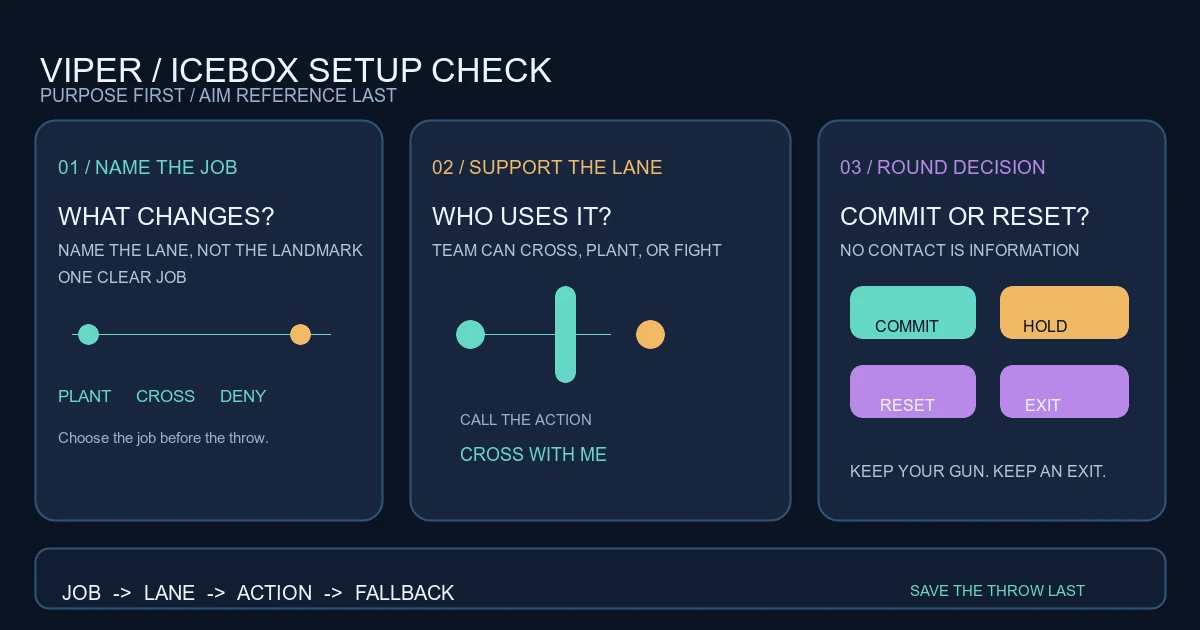
Coaching interpretation: before throwing, answer three questions.
- What lane changes? Say “planter’s crossing” or “defuse access,” not “site covered.”
- Who can use that change? Name the teammate who crosses, plants, swings, or holds the exit.
- What happens if nobody contests? Stop, take the space, plant, or keep the utility for the next decision.
This check prevents a common ranked mistake: throwing a wall because the round has started, then discovering that nobody is close enough to benefit. If Toxic Screen blocks a view but your entry player is still waiting for a different angle, the wall may have spent fuel without changing the fight. If Poison Cloud protects the planter but you leave the team to line up a Snake Bite, the plant can become a solo gamble.
Icebox also punishes the habit of checking one eye level and calling the lane clear. Before committing to a throw, scan the other visible layer and the movement route that can interrupt the plant. The exact check depends on the round and the current map state, so do not turn it into a fixed callout order. The existing Icebox angle-clearing guide is useful for practising that visual habit.
Make the setup create usable space
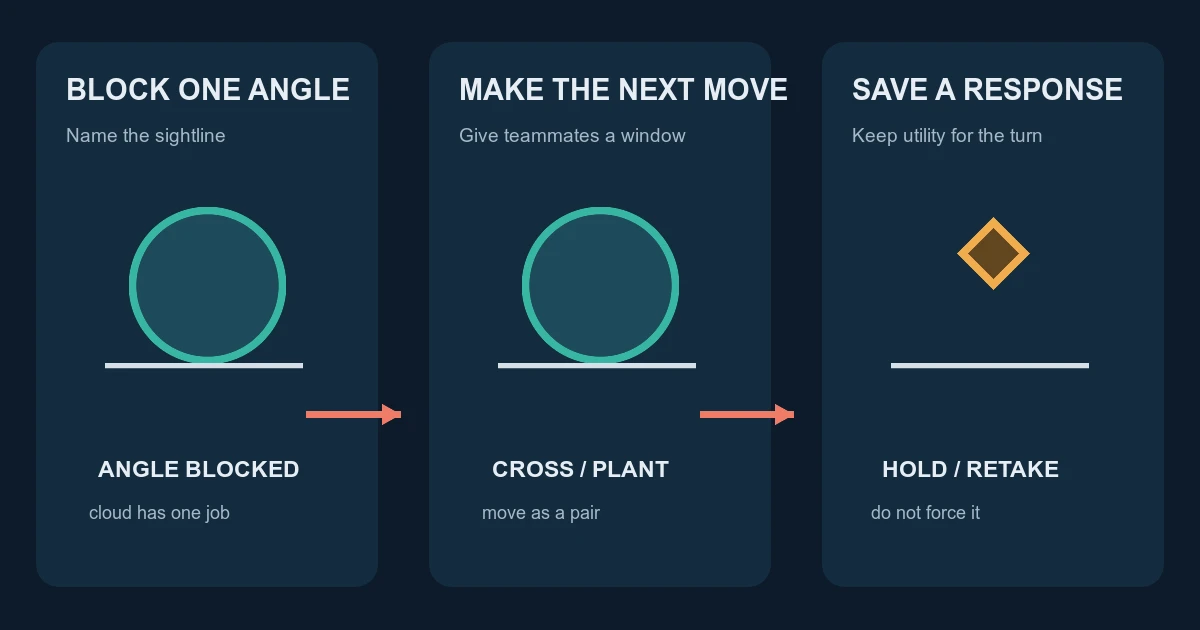
A wall or orb is not valuable because it looks clean on the minimap. It is valuable when the team can occupy the changed position and take a next action. That is the coaching idea behind playing for space: ask which enemy option changed, who can use the new route, and where the team can retreat if the fight goes wrong.
In a ranked round, give the setup a spoken trigger. “Wall up, cross with me” tells a teammate what to do. “Wall” does not. Keep your weapon ready when the plant lane is contested. If the first player sees nobody, do not force a swing just to prove the lineup worked. Holding the changed lane, planting under support, or resetting behind cover can all be successful next actions.
Test it in more than one round shape
Run the setup during a slow attack instead of only during a full execute. The defaulting guide explains why a slower round can preserve choices. For Viper practice, that means you can learn whether the setup still helps when defenders react early, when a teammate is late, or when the team changes its plant plan.
Change one variable at a time in a custom game. Start from the intended reference, throw the ability, and describe the lane it affects. Then repeat with a teammate walking the route and a different expected defender view. Note what remains open. If the throw only works while everyone stands still and gives you uninterrupted setup time, it is a clip, not a ranked tool.
Only after that should you memorise the aim reference. Save the lineup by purpose: “plant-lane wall from a safe start” is more useful than a landmark name you may forget. Add the condition that makes it worth using, the teammate it supports, and the fallback when contact arrives early. A good Viper setup is not the one you can recite fastest. It is the one you can explain, adapt, and abandon without losing the round.
Sources checked
- Viper | Riot Games | checked in a real browser 2026-08-14 UTC. Used for Viper’s Controller role and the rendered descriptions of Poison Cloud, Toxic Screen, Snake Bite, and Viper’s Pit.
- VALORANT Maps | Riot Games | checked in a real browser 2026-08-14 UTC. Used for the rendered Icebox description, including the arctic Kingdom excavation setting, two snow-and-metal plant sites, horizontal finesse, and ziplines.